Collegeville Institute – Short-Term Residential Scholar (2022)
I’m excited to work on my upcoming book project as a Short-Term Residential Scholar at the Collegeville Institute (Collegeville, MN) this coming February and March!
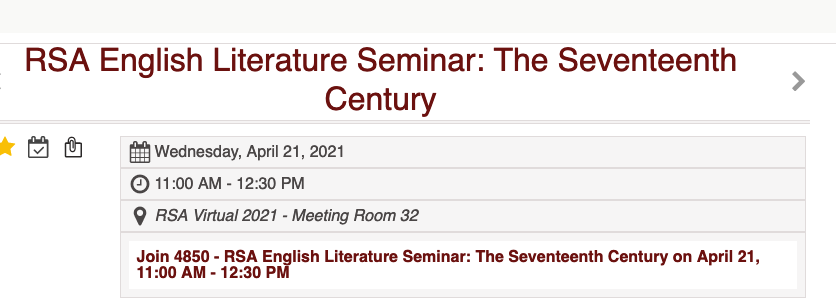
RSA: The Seventeenth Century
Excited to discuss my work in this morning’s Renaissance Society of America panel on seventeenth-century literature in what promises to be a wide-ranging discussion about genre, memorializing the past, and material culture.
Feature: Teaching in a Pandemic
Interview: Tony Brown on Paul Robeson’s life and legacy
Baritone Anthony Brown talks with Prof. Donovan Tann about Paul Robeson’s impact and legacy as well as his show, “I Go On Singing,” which celebrates Robeson’s life and work. Brown has been a part of Hesston College (Hesston, KS) for some time, including serving as Artist in Residence. For more on Brown’s show, “I Go On Singing,” visit: https://igoonsinging.com/
New Publication: Experimental Science and Speculation in Cavendish’s Convent of Pleasure
More details at Project Muse: https://muse.jhu.edu/article/782995?fbclid=IwAR2Ga0TwFD2me6fVTQ12XNBPNUlkkX94u6LdhvuA8hCv38JHQ-2eOz6ugMc
Discovering New Voices: Hesston College
Grad School Q&A: Donovan Tann reflects on the courses and professors who shaped how he now teaches [external link]
Donovan Tann is a 2008 graduate of Eastern Mennonite University who now teaches courses in literature, writing and film at Hesston (Kansas) College. A member of the Lilly Graduate Fellows Program’s first cohort, he earned his English PhD at Temple University in Philadelphia.
How did your academic studies and professors at EMU prepare and inspire you for your graduate studies and/or current work?
Being able to have a faculty member as my advisor at EMU helped me to select coursework that interested me and which has contributed to my scholarship in unusual ways. I might not have taken as much interest in religion’s role in the early modern world without my introduction to theology course. I also had the flexibility to take senior English seminars in both French postmodern literature and transatlantic modernism, and these courses helped to prepare me for graduate school and to develop my voice as a literary scholar.
The mentorship that I received as a student, both formally through the honors program and informally within the language arts department, was crucial to my decision to pursue graduate study. I developed important intellectual virtues of critical thinking and reflection with my honors cohort, and I was honored to share an informal weekly lunch with Jay B. Landis in my last years at EMU. I’m immensely grateful for the way that my professors invested in me as a person and future teacher-scholar.
“What the storyteller narrates must necessarily be hidden from the actor himself, at least as long as he is in the act or caught in its consequences, because to him the meaningfulness of the act is not in the story that fellows. Even though stories are the inevitable results of action, it is not the actor but the storyteller who perceives and ‘makes’ the story”
-Hannah Arendt, The Human Condition
First day of class
from The Idea of a University, Cardinal Newman (John Henry Newman)
“It is a case of contract:—’I will speak, if you will listen:’—’I will come here to learn, if you have any thing worth teaching me.’ In an oratorical display, all the effort is on one side; in a lecture, it is shared between two parties, who co-operate towards a common end.”
“The result is a formation of mind,—that is, a habit of order and system, a habit of referring every accession of knowledge to what we already know, and of adjusting the one with the other; and, moreover, as such a habit implies, the actual acceptance and use of certain principles as centres of thought, around which our knowledge grows and is located. Where this critical faculty exists, history is no longer a mere story-book, or biography a romance; orators and publications of the day are no longer infallible authorities; eloquent diction is no longer a substitute for matter, nor bold statements, or lively descriptions, a substitute for proof. This is that faculty of perception in intellectual matters, which, as I have said so often, is analogous to the capacity we all have of mastering the multitude of lines and colours which pour in upon our eyes, and of deciding what every one of them is worth.”
[Source: http://www.newmanreader.org/works/idea/article9.html ]

